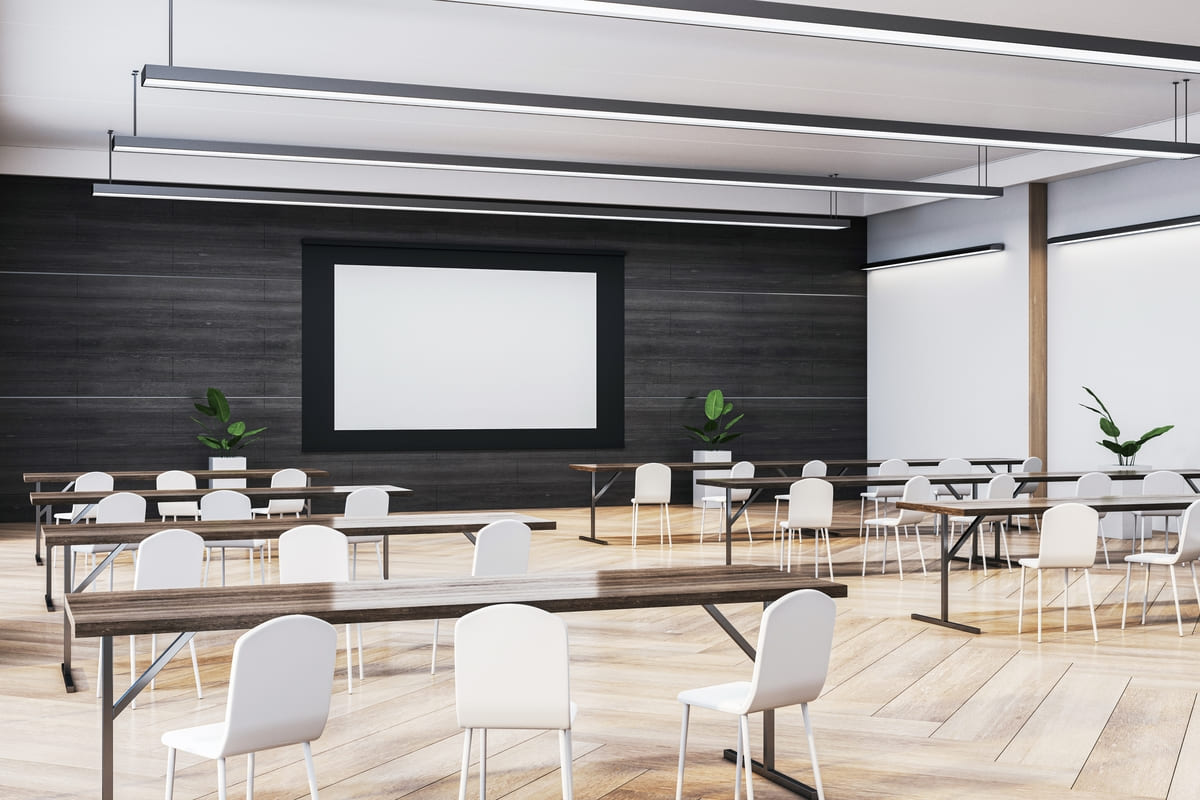
 Lighting in schools has a much greater impact than we imagine: it influences the attention, concentration, but also the well-being of students and teachers. A well-lit learning space means not only better visibility at the blackboard or on the notebook, but also a more pleasant environment, in which children feel encouraged to be active and creative. Natural light is ideal, but when it is not enough, modern lighting solutions come to the rescue with friendly and efficient technologies.
The basic rules in school lighting are uniformity, appropriate intensity and avoiding visual fatigue. Correct lighting prevents headaches, improves concentration and supports school performance. At the same time, modern schools are looking for sustainable solutions that reduce energy consumption and protect the environment.
Whether we’re talking about classrooms, labs or gyms, every space needs a tailored approach. From energy-efficient LED fixtures and smart dimming systems to mood-changing lighting scenarios, there are plenty of affordable options. In this article, we’ll explore practical recommendations and modern ideas to make your school a friendlier, healthier and more inspiring place for everyone who uses it.
Standards and requirements in school lighting
Compliance with school lighting regulations is not just about compliance, but also about the visual health and performance of students. Each space requires different specifications, and an inappropriate choice can generate discomfort or even safety risks.
Adequate lighting levels
A precise calculation of light illuminance (expressed in lux) for each type of activity supports students’ attention and prevents fatigue. Here are the general guidelines:
|
Space |
Recommended light intensity (lux)
|
Observations
|
|
Classrooms
|
300-500 lux |
light focused on the students’ desks
|
|
Laboratory
|
500-750 lux |
necessary for precision and observation activities
|
|
Corridors, locker rooms, transit areas
|
100-200 lux |
enough to ensure safety in motion without unnecessary energy consumption
|
|
Gyms or libraries
|
level adapted to the function |
ex: over 500 lux for library shelves and reading areas
|
Choose lighting fixtures that allow for this differentiation and do not use the same solution for the entire school.
Color temperature suitable for educational environments
The tone of light influences energy levels and relaxation. For activities that require concentration, opt for cool, white light (4000-5000 Kelvin). In relaxation or recreation spaces, warm light (2700-3000 Kelvin) works better, inducing a state of calm. For example, in the library or cafeteria, warm lights help to relax the environment.
Even light distribution and avoidance of shadows
Good lighting doesn’t leave dark areas or cause temporary blindness. Distribute lighting sources so that every corner of the classroom receives enough light. Use suspended versions in the main rooms and recessed or surface-mounted LED spotlights for concentrated workspaces. This way, students don’t struggle with shadows on their notebooks or distracting reflections on smart boards.
Accurate color reproduction and brightness management
A CRI (color rendering index) of at least 80-90 is recommended. Colors appear natural and children easily perceive visual information, which is useful in art or science classes. For visual comfort, limit the unglare index (UGR) below 19 and opt for flicker-free technologies.
Safety and quality standards
Comply with European Directives (CE), EN45014, NP061 and ISO9001 standards for quality management. Make sure that all fixtures are fire-resistant, electrically insulated and do not contain environmentally harmful materials. When designing a new system or retrofitting, work with specialists who are familiar with these regulations. For examples of professional design, see Visioluce lighting design services.
The benefits of LED solutions for schools
Switching to LED technology provides benefits for administrators, students, and teaching staff. In the long term, these systems bring efficiency, reduce costs, and increase user comfort.
Reducing energy consumption
LEDs consume considerably less energy than incandescent or fluorescent bulbs. For example, a school that replaces old fixtures with LED models can see consumption reductions of up to 70%. In addition to the economy, the EU has adopted restrictions on fluorescent sources, which is steering the entire market towards energy-efficient alternatives.
Long service life and easy maintenance
A quality LED fixture can last over 50,000 hours of operation. In schools, where hours of operation extend throughout the day, this duration reduces replacement and maintenance interventions, leading to additional savings in the long term.
Possibility of advanced light control
LED technology allows for adjustable intensity and color temperature. This allows the teacher to quickly adapt the light to the activity being performed – written exercises, presentations, group discussions or games. A dimming system helps to avoid visual fatigue and supports the biological rhythm of students.
Low impact on the environment
LED systems do not contain mercury or other toxic substances, UV and IR emissions are non-existent, and most of the components used can be recycled. By opting for LED, the school becomes more environmentally friendly and aligns its image with modern sustainability standards.
Preventing visual discomfort
LED lighting provides stable light, without visible fluctuations. For example, if sources with low UGR and CRI above 90 are installed in laboratories or at workbenches, students do not complain of headaches or eye fatigue, and activities proceed smoothly.
Lighting adapted to outdoor spaces
For outdoor areas – walkways, building access or courtyards – lighting fixtures such as Andromeda 24, an adjustable and resistant model, or Atlas 3, a recessed fixture for discreet markings, provide guidance and safety, while maintaining the same level of efficiency and reliability.
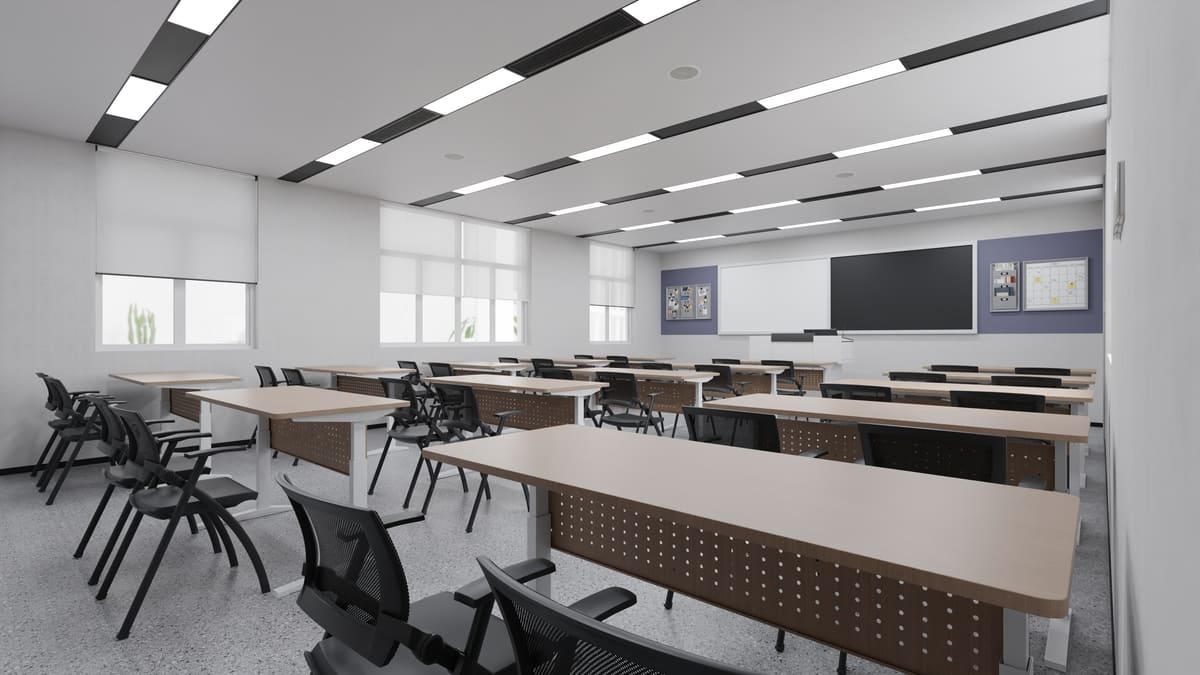
The stages of designing a high-performance school lighting system
A well-thought-out lighting project starts from the analysis of specific needs and continues through to maintenance. Each step contributes to optimal system operation, controlled costs, and user satisfaction.
-
Space analysis and requirements identification
Clearly determine which areas require general lighting (classrooms, corridors) and where specific lighting is needed (laboratories, libraries, gyms). Conduct a lighting study to determine the optimal level of lux, color temperature, and uniformity.
For example, in IT or chemistry rooms, teachers often signal the need for intense, shadow-free lighting, while in play or relaxation areas the emphasis is on diffused light.
-
Selecting the right equipment
Choose LED lighting fixtures for all areas, adapted to requirements:
-In large classrooms, opt for suspended fixtures;
-In laboratories or places exposed to dust/vibration, use robust, flicker-free models with low UGR;
-In detail spaces (art, biology), provide sources with a CRI above 90.
The recommendation is to avoid mixing sources with different color temperatures in a single room.
-
Optimal positioning of fixtures
The correct layout is as follows:
-Sources placed evenly, avoiding students standing with their backs to the window or having their shadow on their notebooks;
-In hallways, combine main lighting with accents that highlight stairwells or high-traffic areas;
-In large rooms, distribute the lighting so that no visual discontinuities are created between the areas by the board and those by the windows.
A concrete example: in a classroom with abundant natural light on the left side, supplement artificial lighting on the right side to balance the contrast.
-
Collaboration with specialised professionals
A lighting design specialist optimises the project, adapts the specifications to the requirements of the space and guarantees compliance with regulations. Make sure that the designers and electricians are licensed and experienced in the field.
-
Periodic monitoring and maintenance
Make regular system checks part of your school’s routine. Gather feedback from teachers and students about poorly lit areas or temporary blinding situations. Schedule maintenance and adjustments to maintain efficiency and safety. This will help you avoid additional costs and unpleasant interruptions.
Practical recommendations and resources for professionals
Plan ahead, evaluate the specifics of each area, and work with specialists to build an effective lighting environment. Call on:
-Certified LED fixtures, with high CRI and low UGR;
-Intelligent systems with presence sensors and natural light detection;
-Periodic maintenance and adjustments based on observations from school staff;
-Consulting from Visioluce specialists for lighting design projects adapted to your space.
Get inspired by the models available in the office project gallery, adapting the concepts to the requirements of the school environment. Carefully chosen lighting removes barriers and creates a place where ideas grow – thus the space becomes not only functional, but also aesthetic.
Frequently Asked Questions
Why is proper lighting important in schools?
Adequate lighting not only means better visibility, but also visual comfort, increased concentration and reduced fatigue. Light influences the well-being, attention and performance of students, but also the working conditions of teachers.
What light intensity is recommended in schools?
In classrooms, an intensity of 300-500 lux is recommended, in laboratories between 500-750 lux, and in corridors and transit areas between 100-200 lux. Gyms or libraries require levels adapted to their function.
What color temperature is suitable for school lighting?
For activities that require concentration, cool, white light between 4000 and 5000 Kelvin is recommended. In relaxation areas, such as the cafeteria or library, warm light between 2700 and 3000 Kelvin creates a peaceful and friendly atmosphere.
What is CRI and why does it matter?
CRI, or color rendering index, shows how accurately a light source reproduces colors. A CRI of 80-90 or higher ensures natural colors, which is essential in art, science, or lab classes for correct visual perception.
What advantages does LED lighting offer in schools?
LED lighting systems use up to 70% less energy than traditional bulbs. In addition, they have a much longer lifespan, which reduces maintenance and replacement costs in the long term.


