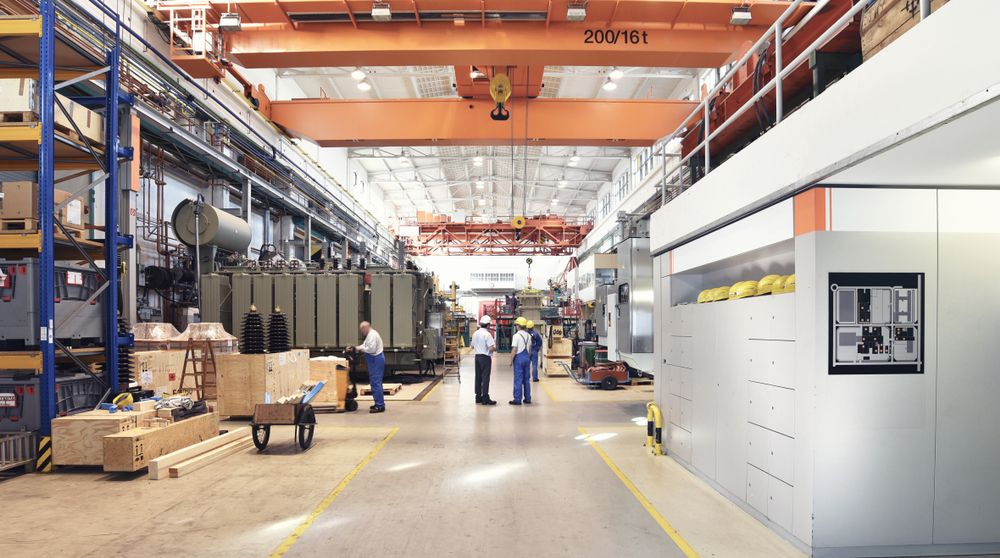
Lighting in an industrial hall is not just about visibility. Light influences employee safety, productivity levels and daily operational costs. A well-thought-out industrial lighting system contributes to an efficient workflow, reduces visual fatigue and minimises the risk of accidents. The correct choice of lighting fixtures must be made depending on the activity, the size of the hall, the ceiling height and the specifics of each work area.
The most common mistakes in industrial hall lighting
Here’s what to avoid when thinking about how to choose technical lighting fixtures and lighting systems for halls:
Insufficient and uneven lighting
One of the most common problems is uneven light distribution. Dark areas, strong shadows or high contrasts reduce visibility and increase the risk of accidents. In addition, operators working in insufficient light conditions tire more quickly, which affects productivity and accuracy.
Ignoring energy efficiency
Using outdated light sources or low-efficiency fixtures significantly increases operating costs. In a hall that operates 8–16 hours a day, the difference in consumption can mean thousands of euros per year. Modern LED fixtures offer high energy efficiency, long lifespan and minimal maintenance, making them a sustainable solution in the long term.
Lack of adaptation to the activity
Not all areas in a hall require the same type of light. Lighting for production lines, storage areas or circulation spaces needs to be thought out differently. A fine assembly area needs intense, precise and colour-accurate light, while a transport aisle requires more diffuse light, geared towards visual comfort.
Criteria for choosing lighting fixtures for industrial halls
How do you know if you need industrial LED floodlights or other systems for general lighting, accent lighting, or for specific activity areas? Here are the most important selection criteria:
Analysis of usage needs
A lighting project always starts with an analysis of the environment: the dimensions of the hall, the ceiling height, the type of activity and the safety requirements. The lighting levels (lux), the uniformity and the light distribution for each area are calculated. The light is not simply installed — it is designed. It is calculated, simulated and adjusted until the luminous flux is optimal for each space. Only then does the solution become a reality.
When comparing industrial lighting products and solutions, consider:
–energy efficiency: a modern lighting fixture should exceed 100 lm/W. This aspect directly influences the operating cost and long-term consumption.
–component lifespan: quality models indicate a lifespan of at least 25,000-50,000 hours and maintain the luminous flux at over 80% of intensity for a long time (see type specification L80/B10);
–light quality: color temperature between 4000K and 6500K, with a minimum CRI of 80 – in industries with visual inspection, a CRI above 90 is required (a cool light, for example, supports attention in production spaces);
-Certification compliance: CE, RoHS and EN12464-1 labels indicate compliance with European safety and energy efficiency regulations.
Choosing the right fixtures
After determining the needs, lighting fixtures are chosen based on:
–type of installation – surface-mounted, suspended or recessed;
–ceiling height – high-bay for high ceilings, low-bay for lower spaces;
–degree of protection – IP and IK corresponding to the environment (dust, humidity, vibrations);
–distribution angle – for uniform lighting and shadow reduction;
–colour temperature and CRI – adapted to the activity (neutral/cool and CRI > 80).
There are several variants dedicated to industrial environments, each designed for a specific use:
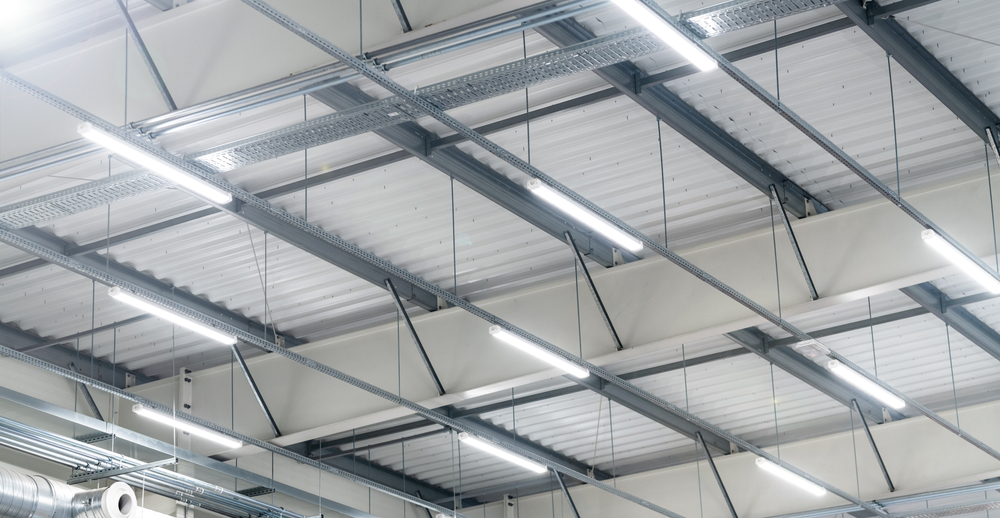
–LED high-bay/UFO fixtures: for halls with high ceilings (over 8 meters) – provides a wide, intense distribution to reduce shadow areas (LED models in the Titan range are suitable for warehouses or heavy production areas);
–linear fixtures or LED panels: for spaces with medium or low ceilings, for continuous lighting between shelves or technological lines (Display Line series, with quick assembly and special diffusers to reduce glare);
–LED industrial floodlights: for the exterior of halls, but also for loading ramps or interior courtyards (models like Titan or Proton II are robust and resistant to weather conditions);
-adjustable fixtures and LED spotlights: for precision lighting or in visual inspection areas, including with custom optics (e.g. Galaxy series);
Suitability to the design and identity of the space
An industrial lighting project is not just about technical calculations. It is a balanced combination of functionality, aesthetics and emotion. Light can completely transform the perception of a space – it can make a hall seem taller, cleaner or safer. By choosing the right fixtures and an appropriate color temperature, you can highlight areas of interest, create a dynamic atmosphere and highlight design or brand elements. Consult industrial lighting solutions for more detailed options.
|
Selection criterion
|
Why it matters for industrial hall lighting
|
Recommendations from Visioluce
|
|
Illumination level (lux)
|
Measures the intensity of light on the work surface. Determines the visibility and accuracy of the activity
|
200–300 lux for warehouses; 500–750 lux for production; 800–1000+ lux for inspection or fine assembly
|
|
Luminous uniformity (Uo)
|
Ratio between minimum and average lighting. Avoid shadows and high contrasts
|
Uo ≥ 0.6 for production halls; Uo ≥ 0.4 for warehouses
|
|
Color temperature (CCT)
|
The tone of light influences the perception of the environment and the state of alertness
|
4000K (neutral) for comfort; 5000–6500K (cool) for technical or precision tasks
|
|
Color rendering index (CRI)
|
Measures color fidelity. Important in activities where details or colored materials are worked with
|
CRI ≥ 80 for most halls; CRI ≥ 90 for quality control, textiles, food
|
|
Energy efficiency (lm/W)
|
Shows how much light is obtained per watt consumed. Affects operating costs
|
≥ 130 lm/W for modern LED fixtures
|
|
Light distribution
|
The direction and angle of the light flux. Determines how the space is covered
|
Medium – for general areas; Wide – for open spaces; Asymmetric – for walls, shelves, conveyor belts
|
|
Degree of protection (IP)
|
Dust and moisture resistance
|
IP65 for general industrial environments; IP66–IP67 for wet, dusty or outdoor areas
|
Mechanical resistance (IK) |
Protection against shocks or accidental impacts
|
IK08–IK10 for harsh environments
|
|
Mounting type
|
Installation method depending on the hall architecture
|
Suspended for high ceilings, surface-mounted or recessed for low ceilings; magnetic track for flexibility
|
|
Lifespan and maintenance
|
Influences long-term costs |
LEDs with a lifespan of ≥ 50,000 hours, quality driver, easy access for service
|
|
Intelligent control (DALI / sensors)
|
Automation, regulation based on the presence or natural light
|
Recommended for optimising energy consumption and intelligent light management
|
Stages of a lighting project for an industrial hall
From idea to implementation, a lighting project goes through several stages:
- analysis of space and activities – the types of areas are determined (production, storage, offices, circulation);
- lighting simulation – light distribution, luxury level and uniformity are modelled;
- selecting the right fixtures – depending on needs, design and budget;
- integration into the overall design – the aesthetic and technical coherence of the entire project is ensured;
- Implementation and final verification – measure results and adjust for optimal performance.
A well-designed lighting project is not just a technical scheme, but a construction that balances efficiency, functionality and visual emotion. Light thus becomes a living component of the space, capable of influencing the atmosphere, productivity and overall image of the company.
Frequently Asked Questions – How to choose the right lighting fixtures for an industrial hall
Here’s what to consider to create the perfect mix between adjustable luminaires, industrial spotlights, LED tubes, track systems, LED panels and other industrial lighting fixtures:
What is the optimal lighting level for an industrial hall?
The optimal level depends on the type of activity carried out:
-for warehouses or traffic areas – between 200 and 300 lux;
-for production areas – between 500 and 750 lux;
-for inspection, control or fine assembly activities – over 800 lux.
A professional lighting design can determine exactly the right values for each area.
What type of lighting fixtures are most often used in industrial halls?
The most commonly used are high-bay and low-bay LED fixtures, chosen depending on the ceiling height.
-High-bay is ideal for high halls (over 8 m), providing concentrated and efficient light;
-Low-bays are suitable for low ceilings (4–7 m), providing diffused and uniform light.
In addition, LED linear fixtures are increasingly popular due to their modern design, ease of installation, and high efficiency.
What is the difference between industrial and commercial lighting?
Industrial lighting is designed for performance and durability – it must withstand dust, vibration, extreme temperatures and continuous operation. Commercial lighting emphasises aesthetics and visual comfort, being used in spaces such as offices, showrooms or stores. In modern halls, the two concepts can be combined through fixtures with minimalist design, but with industrial performance.
How to calculate the number of lighting fixtures needed for a hall?
The exact number of fixtures depends on the area, height, wall colour, type of activity and the luminous flux of each fixture. A professional lighting simulation (specialised software) is performed, which shows the light distribution, uniformity and level of luxury achieved. This avoids dark or overlit areas.
What do IP and IK mean in industrial lighting fixtures?
-IP (Ingress Protection) indicates protection against dust and moisture. For example, IP65 means that the light is completely protected against dust and jets of water.
-IK indicates resistance to mechanical shock. An IK08–IK10 guarantees high protection against impacts or vibrations.
For regular industrial spaces, IP65 is recommended, and for extreme environments (refrigerated, humid, dusty), IP66–IP67 is chosen.
How does colour temperature influence productivity?
Cool light (5000–6500 K) stimulates attention and is ideal for technical or repetitive tasks. Neutral light (4000 K) provides a balance between comfort and visibility, suitable for most halls. Warm light (2700–3500 K) is rarely used in industry, being specific to relaxation areas or offices.
How important is the colour rendering index (CRI)?
CRI (Colour Rendering Index) shows how faithfully colours are perceived under a certain light source.
-CRI ≥ 80 is sufficient for general halls;
-CRI ≥ 90 is recommended in industries such as textile, automotive, food or electronics.
A high CRI reduces visual errors and eye fatigue.
What benefits does LED lighting have over fluorescent or sodium lighting?
LED lighting offers:
-higher energy efficiency (up to 60% energy savings);
-extended lifespan (50,000+ hours);
-instant start and constant flow;
-reduced maintenance and lower long-term costs;
-compatibility with smart systems (motion sensors, DALI control).
Can I use the same type of fixture for the entire hall?
Not recommended. Each area has different needs:
-in the production area, stronger and more concentrated light is needed;
-in warehouses, by directed light between shelves;
-in the corridors, with diffused and comfortable light.
The right choice involves a combination of several fixture types to strike a balance between efficiency and visual comfort.
How can I reduce lighting costs in an industrial hall?
-switching to high-efficiency LED technology (≥ 130 lm/W).
-Implementation of motion sensors or automatic intensity control.
-periodic maintenance of fixtures to maintain the luminous flux.
-choosing a suitable light distribution to avoid system oversizing.
What role does design play in industrial lighting?
Even though the focus is on efficiency, the design of the lighting fixtures influences the way the space is perceived. Modern linear fixtures, such as the Noven range, combine industrial performance with elegant design, integrating perfectly into commercial spaces, offices or showrooms. Light thus becomes part of the company’s visual identity.
Why is a professional lighting project recommended?
Because it eliminates guesswork and guarantees the desired performance. A lighting project:
-optimises energy consumption;
-ensures uniformity and visual comfort;
-complies with safety and ergonomics standards;
-prolongs the lifespan of fixtures.
It is the safest way to achieve correct, efficient and sustainable lighting. Contact Visioluce specialists to design and implement lighting solutions appropriate to the type of hall and the specifics of the industrial activity.
Lighting an industrial hall is a strategic investment, not a secondary detail. The right choice of fixtures, adapting the light to the activity and professional design can make the difference between a tiring space and a productive, safe and visually pleasing one. Through modern solutions and an approach based on analysis and simulation, you can achieve an efficient, sustainable lighting system adapted to the needs of your business.


