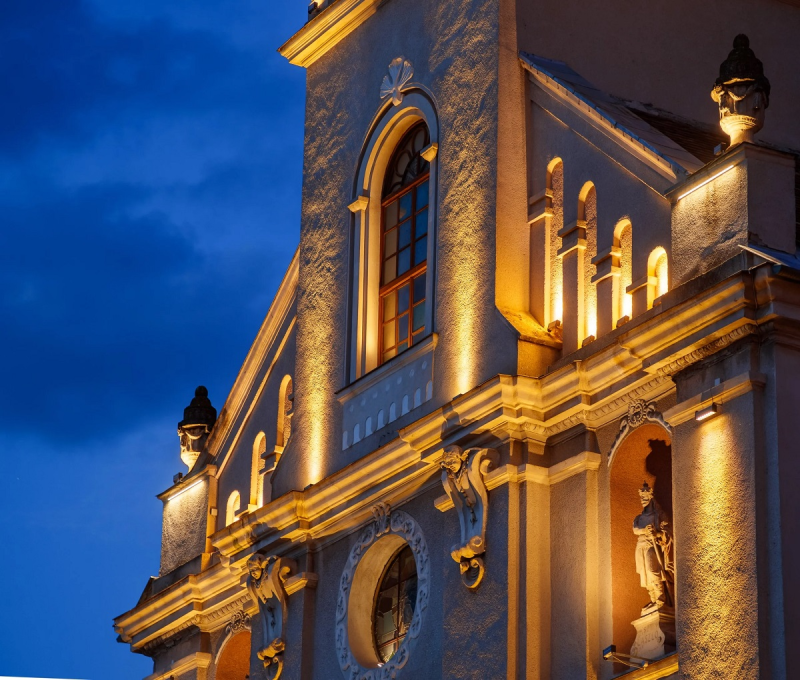
In contemporary exterior architectural lighting, windows are no longer just functional elements of facades, but become visual landmarks that define the nocturnal identity of buildings. Correct window lighting contributes to the volumetric perception of the construction, the compositional rhythm of the facade and the relationship of the building with the urban space.
LED window spotlights represent one of the most effective solutions for accentuating window frames and sills, offering precise control of the luminous flux and a coherent aesthetic impact. The solutions developed by Visioluce are designed for professional architectural lighting projects, combining state-of-the-art LED technology with specialised optics and advanced lighting design.
Window lighting as a tool of architectural composition
Window lighting directly influences how a building is perceived at night. From an architectural point of view, windows define the rhythm of the facade, the proportions of the volumes and the relationship between full and empty. Through lighting, these elements can be accentuated, reinterpreted or integrated into a larger visual concept.
In architectural lighting projects, window accentuation is used for:
-highlighting the modular rhythms of the facades;
-emphasising the historical character of buildings;
-creating contrasts between structural and decorative elements;
-strengthening the visual identity of commercial, residential buildings, hotels, institutions;
-integrating the building into the nocturnal urban scenography.
LED window spotlights allow for directed, precise and controlled lighting, avoiding light dispersion inside the building and reducing environmental impact.
LED window spotlights – elements of professional lighting design
Visioluce’s team of lighting design specialists approach window spotlights as accent elements, playing an important role in the architectural lighting hierarchy. They are integrated into complex systems that include contour lighting, volume lighting, accent lighting and functional lighting.
Relevant lighting parameters
For the correct design of window lighting, several technical parameters are analyzed:
-photometric distribution (beam angle, cut-off);
-luminous intensity (cd);
-luminous flux (lm);
-color temperature (CCT);
-color rendering index (CRI);
-uniformity of lighting;
-glare control;
-compatibility with control systems (DMX, DALI, PWM).
Visioluce projectors are designed to meet these requirements, being developed for professional outdoor lighting applications.
Visioluce solutions for window lighting
Specialized Optics for Window Lighting
A differentiating element of Visioluce solutions is the use of specialized optics for window lighting. These optics allow:
-directing the light flux exclusively onto the window sill and frame;
-limiting the penetration of light into the interior;
-achieving a clear and elegant visual effect;
-reducing light pollution.
The optics are designed to create a precise line of light, adapted to the window proportions and facade lighting.
Dedicated lighting fixtures – the Helios example
In the Visioluce portfolio, the Helios series of lighting fixtures represents a relevant example of a lighting fixture designed for window lighting in architectural projects.
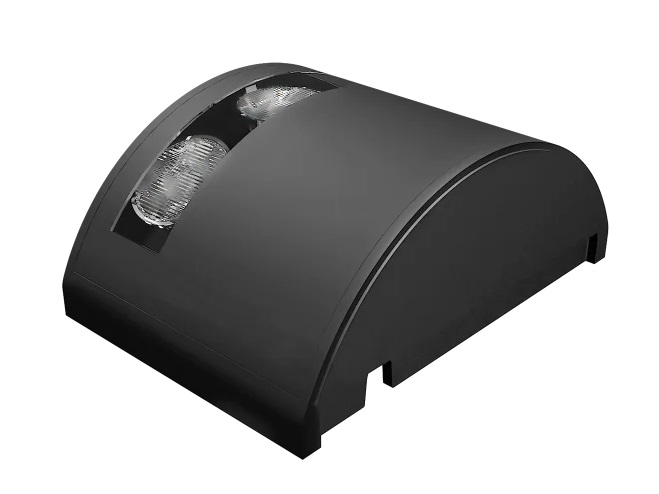
From a technical point of view, this type of lighting fixture is distinguished by:
-integrated LED source;
-insulation class II;
-IP67 protection rating, suitable for outdoor applications;
-high mechanical resistance (IK9);
-the possibility of using colored LEDs or LEDs with different color temperatures.
These features allow the luminaire to be integrated into complex projects (both historic buildings and contemporary architecture).
Integrating window spotlights into the overall lighting concept
In professional projects, window lighting is not designed in isolation, but as part of a global architectural lighting concept. Visioluce offers not only lighting fixtures, but also lighting design services, 3D simulations and photometric calculations.
Stages of the design process
The window projector integration process includes the following steps:
- architectural analysis of the facade;
- defining the concept of lighting;
- selecting types of lighting fixtures;
- lighting simulations;
- optimization of positioning and parameters;
- implementation and final adjustment.
This approach allows for coherent, efficient lighting that is tailored to the specifics of each project.
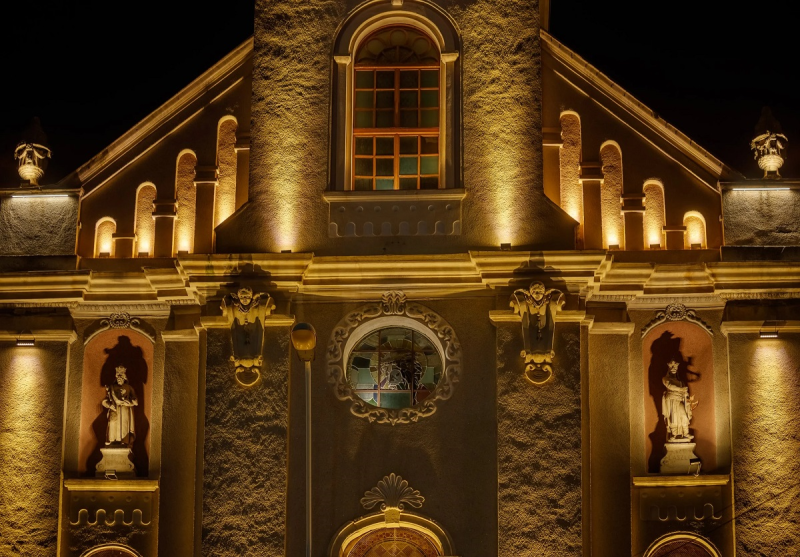
Technological advantages of LED window luminaire
Energy efficiency and sustainability
The LED technology used by Visioluce offers an optimal ratio between light performance and energy consumption. In the current context, in which urban projects are also evaluated from a sustainability perspective, this aspect becomes essential.
Window lighting with LED projectors contributes to:
-reducing energy consumption;
-reducing operating costs;
-compliance with energy efficiency standards;
-reducing the carbon footprint.
Durability and reliability
Outdoor lighting fixtures must withstand extreme environmental conditions: temperature variations, humidity, dust, and vibrations. Visioluce solutions are designed for long-term use, with materials and technologies that ensure stable performance over time.
Flexibility in lighting scenarios
Window projectors can be integrated into dynamic lighting scenarios, including:
-static lighting with constant color temperature;
-RGB or RGBW lighting;
-dynamic scenarios for urban events;
-integration into smart lighting systems.
This flexibility allows the lighting to be adapted to the visual identity of the building and the urban context.
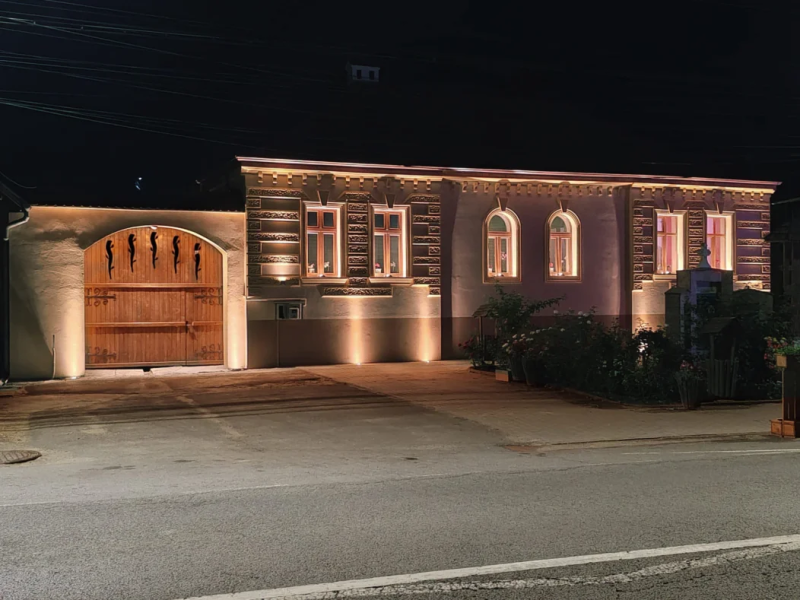
Professional applications of LED window projectors
Visioluce solutions are used in various lighting and creative design projects:
Historical buildings and monuments
In heritage buildings, window lighting must respect the original architectural character, avoiding aggressive visual interventions. LED projectors with dedicated optics allow for accentuation of details, without altering the authentic perception of the facade.
Hotels and hospitality spaces
In Horeca, window lighting contributes to creating a distinct nocturnal identity. Visioluce proposes creative ideas for hotel lighting that improve brand perception and user experience.
Office buildings and commercial spaces
For office buildings, window lighting can highlight the modular structure of the facades and contribute to the visual positioning of the building in the urban landscape.
Public spaces and urban developments
In urban projects, window lighting is part of a broader public and architectural lighting strategy, contributing to the quality of the night space.
Technical guide for choosing LED window spotlights
For specialists, the selection of window projectors must take into account several factors:
Architectural features of the facade:
-window size;
-facade materials;
-the depth of the frames;
-the relationship between windows and volume.
Lighting parameters:
-the angle of the light beam;
-light intensity;
-uniformity of lighting;
-brightness control.
Environmental conditions:
-mechanical resistance IK.
Integration into the control system:
-DMX/DALI compatibility;
-the possibility of dynamic scenarios.
| Technical criterion
|
Description
|
Impact on architectural lighting
|
Recommendations for professional projects
|
LED projector recommendations for windows – Visioluce
|
| Optical type
|
Dedicated window optics (asymmetric, elliptical)
|
Allows precise illumination of the window sill without stray light
|
Asymmetric optics for light flux control
|
Helios – window lighting fixture with special optics |
| Beam angle
|
Beam angle (°)
|
Determines the visual focus on the window
|
elliptical configuration – architectural windows
|
Helios – optical configuration adapted to architectural windows
|
| Photometric distribution
|
Luminous intensity distribution curve
|
Influences the perception of facade volumes
|
Choosing the distribution based on the window proportions
|
Helios – targeted distribution for framing
|
| Luminous flux (lm)
|
Total amount of light emitted
|
Controls the level of architectural emphasis
|
Adjusting the flow according to the facade materials
|
Helios – power variants adapted to the project
|
| Luminous intensity (cd) | Focusing light in one direction
|
Highlights architectural details
|
Avoiding overexposure of windows
|
Helios – precise and controlled lighting
|
| Color temperature (CCT)
|
Light tone (K)
|
Influences the aesthetic perception of the facade
|
2700–3000K for heritage, 3000–4000K for contemporary architecture
|
Helios – 3000K, 4000K, 5000K
|
| CRI (color rendering index)
|
Color fidelity
|
Impact on the perception of materials
|
CRI ≥ 80 for architectural lighting
|
Helios – CRI 80 |
| Glare control
|
Reducing glare
|
Increases urban visual comfort
|
Cut-off optics and anti-glare screens
|
Helios – specialized optics for glare control
|
| Degree of protection (IP)
|
Dust and water resistance
|
Outdoor reliability
|
IP65–IP67 for architectural applications
|
Helios – IP67 |
| Mechanical resistance (IK)
|
Impact protection
|
Sustainability in the urban environment
|
IK08–IK10
|
Helios – IK9 |
| Case material
|
Aluminum, treated materials
|
Heat dissipation and durability
|
Anodized / powder-coated aluminum
|
Helios – robust outdoor housing |
| Control system
|
DMX, DALI, 1–10V, on/off
|
Allows dynamic scenarios | Integration into smart lighting systems
|
Helios – DALI, 1–10V, on/off options
|
| Color LED / RGB | colored LEDs
|
Allows dynamic scenarios
|
Controlled use in urban projects
|
Helios – colored LEDs on demand
|
| Integration into the facade concept
|
Correlation with other lighting fixtures
|
Visual coherence of the facade | Combination with adjustable and linear fixtures
|
Visioluce adjustable LED outdoor lighting fixtures for volumetric accents
|
| Integration with general architectural lighting
|
Relationship with other types of lighting
|
Building the night scene
|
Combination with linear systems and wall washers
|
Visioluce outdoor luminaire range for facades
|
Frequently asked questions about LED windows luminaires
Here are the most important details about these outdoor lighting fixtures:
What are LED window luminaires?
LED window spotlights are outdoor lighting fixtures designed to accentuate window sills and frames, using dedicated optics that control the direction and distribution of light.
What is the difference between window luminaires and linear lighting fixtures?
Linear lighting creates continuous lines of light, while window spotlights are used for point and controlled accents. In architectural projects, the two solutions are often combined.
How to avoid light entering the building?
By using specialised optics and controlled beam angles, window spotlights direct light exclusively onto frames and window sills.
What color temperature is recommended for window lighting?
The choice of color temperature depends on the architectural context:
-2700–3000K for historic buildings and classic facades;
-3000–4000K for contemporary architecture;
-RGB/RGBW for dynamic scenarios.
Are LED window spotlights energy efficient?
Yes. The LED technology used in Visioluce solutions offers high energy efficiency and low operating costs, making it suitable for sustainable projects.
Can window projectors be integrated into smart lighting systems?
Yes. Visioluce projectors can be integrated into control systems such as DMX or DALI, allowing dynamic scenarios and intelligent lighting control.
In what types of projects are these solutions used?
LED window spotlights are used in historic buildings, hotels, office buildings, shopping malls and urban projects.
How to design window lighting correctly?
Through architectural analysis of the facade, lighting simulations, selection of optics and integration into the overall architectural lighting concept.
LED window spotlights are an essential solution in contemporary exterior architectural lighting. They highlight architectural details, define the nighttime identity of buildings and integrate facades into the urban landscape.
Are you looking for specialised optics, advanced LED technology and an integrated approach to lighting design? Contact Visioluce specialists for professional solutions adapted to the requirements of modern architecture. Window projectors are not just light sources, but strategic tools of architectural and urban composition.
